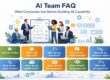

AI strategy for business leaders must begin with alignment. Artificial intelligence is not a technology initiative. It is a business transformation lever. When leaders treat it as a tool purchase or an isolated experiment, initiatives stall and credibility erodes.
The organizations gaining measurable advantage approach AI strategically. They align business objectives, talent capability, infrastructure readiness, governance structure, and ROI measurement from the outset. That alignment determines whether artificial intelligence becomes a growth engine or a cost center.
Start With Clear Business Outcomes
An effective AI strategy for business begins with defined outcomes. Rather than starting with tools or vendors, leaders must first clarify the performance gap they intend to close. Revenue growth, cost reduction, forecasting accuracy, and risk mitigation each require different capability profiles.
When executive teams prioritize platforms before defining impact, investment quickly becomes reactive. Instead, measurable objectives should guide technical decisions. Clear targets sharpen evaluation criteria, align internal stakeholders, and prevent unnecessary experimentation.
Once desired outcomes are documented, leadership can assess whether artificial intelligence represents the right lever. Not every operational inefficiency requires AI. Strategic discipline ensures that investment remains purposeful.
For practical examples of where impact materializes, see AI Use Cases for Business: A Strategic Guide for Executives.
Assess Organizational Readiness Honestly
AI strategy for business leaders must account for internal maturity. Data availability, infrastructure reliability, engineering depth, and executive sponsorship all influence feasibility.
Stable data pipelines are essential because modeling efforts degrade quickly without them. In addition, deployment infrastructure determines whether pilots scale or remain isolated experiments. Most importantly, executive alignment protects AI initiatives from losing budget priority when competing investments emerge.
Therefore, readiness assessment should precede hiring and scaling decisions. Evaluate:
- Data quality and accessibility
- Infrastructure scalability
- Security and compliance exposure
- Cross-functional collaboration norms
When leaders understand constraints early, strategy becomes realistic rather than aspirational.
Align Talent With Strategic Direction
Artificial intelligence strategy cannot succeed without properly aligned talent. Research specialists, production engineers, data engineers, and business translators each serve different functions.
Misalignment between strategy and talent is one of the most common causes of AI stagnation. For example, hiring research-focused data scientists for deployment-driven objectives slows operational progress. Conversely, prioritizing infrastructure talent when innovation depth is required limits competitive differentiation.
AI strategy for business leaders must define sequencing clearly. Who should be hired first? What capabilities must exist before scaling? How will leadership evaluate progress?
These structural decisions determine execution velocity.
The complexity of hiring within this domain is explored further in AI Recruiting: Why Hiring AI Talent Is Different.
Build Versus Partner Is a Strategic Decision
Many executive teams face a build-versus-partner dilemma. Internal AI capability offers long-term differentiation. External partnerships accelerate speed in early stages.
The decision should reflect competitive pressure, timeline sensitivity, and internal maturity.
Organizations entering AI for exploratory experimentation may benefit from partnership. However, companies seeking durable competitive advantage often require internal ownership over time.
AI strategy for business leaders should map this transition deliberately. Define what must remain internal. Identify where external support accelerates progress. Avoid ideological bias in either direction.
Strategic flexibility preserves optionality.
Establish Governance Before Scaling
Artificial intelligence introduces structural risk. Bias, regulatory exposure, explainability requirements, data privacy concerns, and ethical implications require executive oversight.
AI governance must not be reactive. Instead, leaders should establish:
- Clear ownership structures
- Defined model review processes
- Data compliance standards
- Escalation protocols
When governance is embedded early, innovation moves confidently. When it is ignored, setbacks create hesitation and political friction.
AI strategy for business leaders requires balancing velocity with responsibility.
Define ROI Metrics Before Investment Expands
Executives often ask when artificial intelligence will produce measurable returns. However, that question cannot be answered retroactively. ROI expectations must be defined before scaling investment.
To accomplish this, leadership should establish baseline metrics, improvement thresholds, and defined time horizons. In addition, adoption benchmarks should be documented so that operational integration is measurable rather than assumed.
Importantly, ROI does not always translate directly into immediate revenue. In many cases, efficiency improvements, risk reduction, or enhanced forecasting accuracy represent the first wave of value creation.
When metrics are defined early, accountability strengthens. As a result, executive confidence increases and long-term funding becomes easier to justify.
Integrate AI Into Core Operations
Artificial intelligence must integrate into operational workflows. Pilot projects generate insight, but enterprise value emerges only when AI is embedded within product, operations, marketing, finance, or supply chain systems.
Some organizations centralize AI within a dedicated team. Others embed talent within business units. The appropriate model depends on scale, maturity, and strategic intent.
Regardless of structure, executive sponsorship is essential. Visible leadership commitment signals permanence and reduces organizational resistance.
AI strategy for business leaders succeeds when artificial intelligence becomes part of how the company operates, not an initiative layered on top.
Transition From Experimentation to Institutional Capability
Many companies remain trapped in pilot mode. Models are built, but operational integration never materializes. To prevent stagnation, leaders must define clear scaling thresholds and deployment criteria from the outset.
A structured rollout plan, supported by infrastructure readiness and governance alignment, increases the likelihood of durable success. The sequencing required to move from experimentation to enterprise capability is explored in AI Implementation Strategy: From Pilot to Production.
Without disciplined execution, experimentation becomes an isolated activity rather than a competitive advantage.
Leadership Alignment Determines Longevity
Artificial intelligence strategy cannot survive without executive cohesion. Competing priorities, shifting budgets, and leadership turnover often derail progress.
Therefore, AI strategy for business leaders should include:
- Cross-functional executive alignment
- Clear communication of strategic intent
- Defined ownership across departments
- Periodic strategic review checkpoints
When leadership alignment remains strong, AI initiatives endure beyond early enthusiasm.
Competitive Advantage Comes From Structural Alignment
AI strategy for business leaders ultimately determines whether artificial intelligence becomes a differentiator or a distraction. Competitive advantage does not come from adopting popular tools. It comes from aligning systems, people, and decision-making processes around measurable impact.
Organizations that win with AI integrate it into strategic planning cycles. They connect experimentation results to capital allocation decisions, tie model performance to executive dashboards, and treat artificial intelligence as part of the operating model, not as a technical overlay.
Moreover, they commit to long-term capability building. Talent development, infrastructure upgrades, governance refinement, and performance measurement evolve continuously. AI strategy is not static. It requires periodic reassessment as data volumes grow, regulations shift, and competitive pressure increases.
Business leaders who view AI as a multi-year structural initiative build momentum that compounds. Those who approach it opportunistically often reset every budget cycle.
AI strategy for business is therefore not about technical ambition alone. It is about disciplined integration into the organization’s strategic core.
Strategy Precedes Hiring
One of the most costly mistakes organizations make is hiring before defining strategy. Urgency drives recruitment activity. However, without clarity, hiring becomes speculative.
AI strategy for business leaders defines role sequencing, compensation boundaries, evaluation criteria, and performance expectations before talent acquisition begins.
Hiring without strategy creates confusion. Strategy without hiring creates stagnation. Alignment between the two creates momentum.
Artificial intelligence is not about adopting trends. It is about designing capability deliberately.
Organizations that align talent, technology, governance, and ROI within a cohesive AI strategy for business build durable competitive advantage. Those that pursue AI without structural alignment risk wasted capital and lost credibility.