
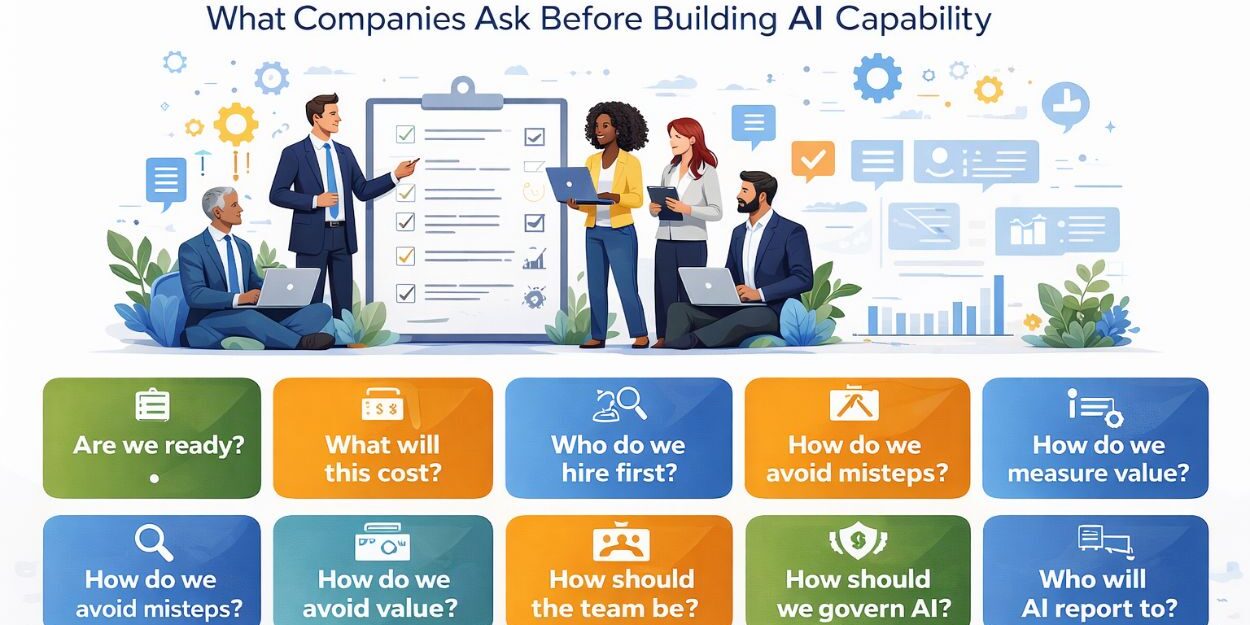
Before investing in artificial intelligence, most leadership teams begin with questions. An effective AI team FAQ does not focus on technical nuance. It addresses the structural, financial, and operational concerns that surface before organizations commit to building AI capability.
Executives rarely ask, “Which algorithm should we use?”
They ask:
- Are we ready?
- What will this cost?
- Who do we hire first?
- How do we avoid missteps?
- How do we measure value?
These are strategic questions. And answering them clearly determines whether artificial intelligence becomes an asset or an expensive experiment.
For broader context on sequencing and structural planning, see How to Build an AI Team That Drives Business Impact.
How Do We Know If We’re Ready to Build an AI Team?
Readiness is not about having perfect data. It is about having defined business priorities and executive commitment. Companies are ready when leadership can articulate the specific outcomes artificial intelligence is expected to influence, whether that is operational efficiency, risk reduction, customer insights, or product differentiation.
Infrastructure maturity matters, but clarity of intent matters more. Without defined objectives, hiring becomes speculative. With defined objectives, gaps become visible and solvable.
Organizational readiness also includes governance awareness. Leadership should understand how data will be managed, how risk will be evaluated, and how models will be monitored once deployed.
Who Should We Hire First?
The first AI hire depends on the business objective and data maturity. In many early-stage organizations, a senior generalist capable of assessing data readiness, building foundational models, and communicating results to executives provides the most value.
However, if the primary constraint is unstable data infrastructure, the initial priority may be data engineering rather than modeling.
The key is sequencing. Hiring titles without defining responsibility creates confusion. For a deeper framework on first-hire decisions, see Who Should Be Your First AI Hire? A Decision Framework.
How Large Should an AI Team Be at the Start?
Many organizations overestimate initial headcount requirements. Early AI capability does not require a large department. It requires focused execution around prioritized use cases.
A small, well-aligned team can generate measurable value when supported by infrastructure and executive sponsorship. Expansion should follow demonstrated impact rather than anticipation of it.
The goal is not to build an AI department. The goal is to build AI capability that integrates into operations.
What Does an AI Team Cost?
Cost questions surface quickly. Compensation for AI professionals is significant, but salary is only one component. Infrastructure investment, tooling, governance processes, and ongoing monitoring all contribute to total cost of ownership.
Budget planning must align with business value expectations. AI capability should be evaluated as a strategic investment, not a discretionary expense.
For detailed cost considerations, see Budgeting for an AI Team: Compensation, Infrastructure, and ROI.
How Do We Avoid Hiring the Wrong Roles?
Misalignment typically occurs when hiring decisions are driven by market trends rather than internal needs. Companies recruit high-profile titles without understanding how those roles integrate into their existing systems.
An effective AI team FAQ emphasizes capability mapping. Leaders should define required outputs, operational integration pathways, and reporting structures before extending offers.
Clarity reduces turnover risk and accelerates impact.
Should AI Report to IT, Product, or the CEO?
Reporting structure should reflect the organization’s broader strategy and operating model. AI may align most naturally with product development in some environments, while in others it integrates within operations or established data functions. In higher-growth or transformation-focused companies, AI leadership often sits closer to the executive level to maintain strategic alignment and accelerate coordinated decision-making.
What matters most is accountability. Artificial intelligence initiatives require defined ownership, budget clarity, and integration into strategic planning cycles.
Fragmented reporting structures slow decision-making and dilute responsibility.
How Long Does It Take to See Results?
Timelines vary based on use case complexity and infrastructure maturity. However, disciplined organizations typically identify measurable impact within months, not years.
The first objective should not be enterprise transformation. It should be controlled value demonstration. Early wins build confidence, secure continued investment, and inform hiring expansion decisions.
Scaling beyond pilot phases requires structured execution, as explored in AI Implementation Strategy: From Pilot to Production.
What Governance Do We Need Before Scaling?
Governance should not wait until after deployment. Even early initiatives require review processes for data usage, model performance, bias evaluation, and compliance.
Executive teams should establish oversight structures before scaling begins. Governance protects both operational integrity and brand reputation.
Strong governance accelerates adoption because it builds internal trust.
How Do We Measure AI Team Performance?
Performance evaluation should extend beyond technical accuracy. Adoption rates, operational efficiency improvements, revenue influence, and cost reduction all contribute to meaningful measurement.
Artificial intelligence must align with business metrics. If outputs do not influence operational decisions or financial performance, hiring expansion should pause until integration improves.
Measuring what matters reinforces disciplined growth.
What If We’re Not Ready?
Not every organization should hire immediately. In some cases, the appropriate first step is refining business objectives, improving data infrastructure, or securing executive alignment.
An AI team FAQ should include the possibility that preparation precedes recruitment. Artificial intelligence capability requires structural support. Building prematurely often leads to frustration and turnover.
Deliberate preparation often shortens the path to sustainable impact.
Moving From Questions to Capability
Every organization begins with uncertainty. The difference between those that scale AI successfully and those that stall lies in how they answer foundational questions.
An AI team FAQ provides clarity around readiness, hiring sequence, cost structure, governance, and measurement. It frames artificial intelligence as a strategic capability rather than a technology trend.
Companies that approach AI deliberately build functional teams aligned with business objectives. Those that skip foundational questions frequently find themselves rebuilding structure later.
Artificial intelligence is not defined by who you hire first. It is defined by how thoughtfully you sequence capability over time.
Explore More