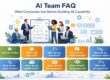

An effective AI hiring roadmap determines whether artificial intelligence becomes a coordinated enterprise capability or remains dependent on one isolated specialist. Many organizations approach their first AI hire reactively. A business unit requests predictive modeling. A board member asks about generative AI. A competitor announces a new automation initiative. A job description goes live.
That approach rarely produces sustainable capability.
Artificial intelligence scales when hiring is sequenced intentionally, aligned with business objectives, and supported by operational infrastructure. The AI hiring roadmap is not about adding headcount. It is about building capacity in a disciplined progression.
For broader executive alignment across AI investment and readiness planning, see AI Strategy for Business Leaders: Aligning Talent, Technology, and ROI.
Phase One: Define the Business Objective Before the Role
The roadmap must begin with business clarity. Before deciding what title to hire, leadership should define the problem artificial intelligence is expected to solve. Is the objective operational efficiency? Revenue expansion? Risk mitigation? Product enhancement?
When organizations skip this step, they default to popular titles rather than strategic need. A “Data Scientist” may be hired when the real bottleneck is data engineering. An “AI Engineer” may be recruited when workflow integration is the core challenge.
The first step in an AI hiring roadmap is mapping capability requirements to prioritized use cases. The hire must reflect the objective. Otherwise, the organization builds talent without direction, which leads to frustration on both sides.
Phase Two: Sequence the First Critical Hire
The first AI hire shapes architectural direction and cultural perception. This individual often influences tooling decisions, infrastructure standards, and future role definitions. Because of that impact, sequencing matters.
In early-stage environments, a senior generalist who can assess data readiness, build foundational models, and communicate with executives often provides more value than a narrowly specialized contributor. In more mature organizations with stable infrastructure, specialization may be appropriate.
The key is role clarity. The AI hiring roadmap should clearly define who owns model development, who stabilizes data pipelines, and who translates outputs into operational decisions. If those responsibilities are ambiguous, the first hire becomes overextended and under-supported.
The initial hire is not just filling a role. It is establishing direction.
Phase Three: Align Talent With Infrastructure and Authority
Hiring talent without supporting infrastructure creates friction. Even exceptional AI professionals struggle when data is fragmented, governance is undefined, or deployment pathways are unclear.
A disciplined AI hiring roadmap aligns recruiting with infrastructure planning. If artificial intelligence is expected to influence core operations, data systems must be stable. Monitoring must be established. Compliance standards must be defined.
Equally important is authority. If AI insights are optional or routinely sidelined, adoption stalls. Executive sponsorship signals that artificial intelligence is part of operational discipline, not a side initiative.
This integration between talent and execution is explored further in AI Implementation Strategy: From Pilot to Production.
Phase Four: Expand Based on Bottlenecks, Not Trends
Once early initiatives demonstrate measurable value, expansion becomes appropriate. At this stage, the roadmap should respond to capability gaps rather than market hype.
When model development advances faster than deployment capacity, the priority may shift toward adding machine learning engineering expertise to productionize systems effectively. In situations where data pipelines remain unstable, strengthening data engineering capability becomes essential. And if adoption across the business begins to stall, introducing a translator role can help bridge technical outputs with operational leadership and drive meaningful integration.
The AI hiring roadmap evolves from individual contributor impact to coordinated team execution. Each hire should remove friction identified in the previous phase. Scaling headcount without identifying bottlenecks simply increases cost without increasing capability.
Disciplined expansion ensures that the team grows in alignment with demonstrated value.
Phase Five: Integrate AI Into Cross-Functional Planning
Artificial intelligence cannot remain siloed within a technical function. As the team expands, finance, operations, product leadership, and compliance functions must become active participants in capability development.
A mature AI hiring roadmap incorporates governance review cycles, performance reporting cadence, budget allocation discussions, and structured integration into strategic planning. Artificial intelligence should influence decision-making across departments, not operate independently from them.
This level of integration reduces dependency on individual champions and embeds AI capability into enterprise rhythm.
Phase Six: Evaluate Internal Capability Development Strategically
Not every capability must be built at once. A disciplined AI hiring roadmap evaluates which competencies are core to long-term strategic advantage and which can be supported externally in early stages.
Organizations may initially rely on advisory support, infrastructure partners, or implementation specialists while building internal ownership of modeling, data engineering, or product integration over time. The decision should reflect long-term business objectives rather than short-term urgency.
The broader sequencing of early AI hiring decisions, including build-versus-partner considerations, is explored in How to Build an AI Team That Drives Business Impact.
Phase Seven: Develop Leadership Bench Strength
As AI initiatives expand, leadership structure must mature. What begins as a technical contributor reporting into IT may evolve into a dedicated AI leader aligned directly with executive strategy.
An AI hiring roadmap should anticipate this transition. Defining reporting structures, accountability models, and long-term leadership requirements prevents fragmentation as the team scales.
Without leadership clarity, teams often drift into disconnected projects rather than coordinated strategy. Clear ownership and executive alignment sustain momentum.
From First Hire to Functional Capability
An AI hiring roadmap is not a static plan. It evolves alongside business priorities, competitive pressure, and technological maturity. Organizations that succeed approach hiring as a strategic sequence rather than a reactive process.
They begin by defining clear business objectives before assigning titles, then sequence roles in a way that builds capability intentionally. Infrastructure investment progresses alongside talent acquisition, ensuring early hires can operate effectively. Expansion follows demonstrated value rather than speculation, with governance and leadership structures evolving in step as the capability matures.
Artificial intelligence becomes sustainable advantage only when talent strategy aligns with business strategy.
The organizations that scale effectively are not those that hire the fastest. They are those that hire deliberately, integrate thoughtfully, and build functional teams with long-term purpose.
Explore More
• AI Strategy for Business Leaders: Aligning Talent, Technology, and ROI
• AI Implementation Strategy: From Pilot to Production
• How to Build an AI Team That Drives Business Impact